The Problem
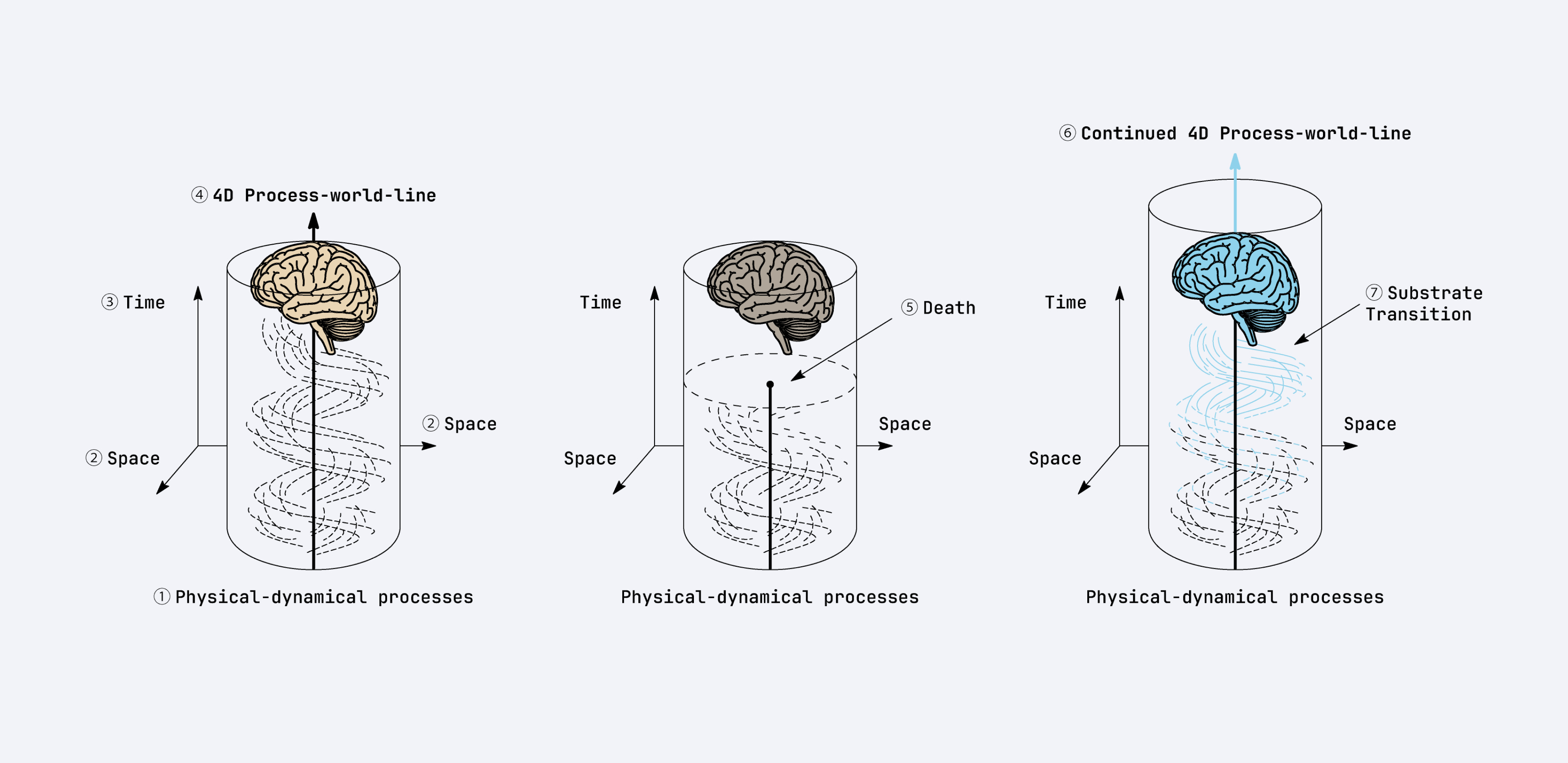
We view death as the irreversible collapse of the physical dynamics that sustain consciousness: the point at which the process-world-line terminates. Existing interventions fail to guarantee the survival of the same conscious process:
-
Longevity research slows substrate failure but leaves consciousness vulnerable to a single point of failure: the biological brain. One accident, one disease, one trauma, and the process-world-line ends permanently.
-
Cryonics/biostasis halts metabolism after death, but we strongly assume that metabolic arrest irreversibly destroys the original process-world-line. Events such as terminal rapid depolarisation sever the causal chain that constitutes conscious continuity.
-
Classical mind uploading terminates the original causal chain and, at best, produces a computational copy, a parallel consciousness, not survival. You die; perhaps a flawed copy continues.
The missing capability is an empirically validated, continuity-preserving method for transferring a living mind to a synthetic substrate. That is what we are building.
Core Principles
Synconetics defines five core principles that any solution must satisfy:
- Process-World-Line Fidelity : Preserve the unbroken four-dimensional causal chain of conscious dynamics.
- Non-Destructive Transition : Migrate function gradually and verifiably, rejecting destructive scanning or copying.
- Substrate Agnosticism with Physical Grounding : Allow transitions to synthetic substrates, but require them to maintain the same physical dynamics as biological systems.
- Empirical Primacy : Rely on measurable physical criteria and first-person reporting, avoiding non-falsifiable speculation.
- Near-Term Engineering Urgency : Utilise existing technologies and adopt a stepwise approach rather than waiting for speculative breakthroughs.
In practice, this means we reject copy-based survival methods. Destructive scanning and approaches that branch or interrupt the original process-world-line do not constitute survival by our criteria. Where simulation-based approaches are considered, we require empirical verification that continuity is preserved. Substrate transitions must be gradual, testable, and validated through both physical metrics and first-person reportability.
Current research directions include biohybrid neural grafts for gradual tissue replacement, artificial hemispheric complements for functional integration via high-bandwidth brain-machine interfaces, and protocols for verifying process-world-line fidelity throughout transition. All work operates under an open-science mandate, protocols, datasets, and hardware designs are published to enable independent replication.
Research Demo
Predictive Neural Scaffold Design
A deep learning approach to engineering synthetic brains. A predictive model generates scaffold architectures that guide biological neural growth toward target morphologies. The same hidden state-space representations that enable the AI to design scaffolds for growing biological neural tissue can be transferred to biohybrid and biomimetic neuromorphic substrates.
Select an algorithm below and observe how different computational approaches solve the scaffold optimisation problem, from stochastic heuristics to deep learning models that learn the generative rules of neural architecture.
Broader Applications
Predictive growth algorithms developed for synthetic brain engineering have wide-reaching implications across adjacent fields where controlled neural architecture construction is critical.
- Neuroprosthetics and brain-computer interfaces
- Gradual brain replacement strategies
- Neuromorphic chip design and layout
- Wetware computing architectures
- Computational neuroscience research
- Anaesthesia research and consciousness monitoring
Theoretical Framework
Process World-Line Dynamics
Operational Consciousness Mechanics provides our mathematical framework for understanding why continuous, gradual substrate transitions preserve consciousness while discontinuous approaches fail. Model A represents a single deterministic trajectory: one perturbation and the process-world-line collapses irreversibly. Model B demonstrates ensemble dynamics with attractor states, where the system self-corrects around its operational basin, maintaining continuity through adaptive resilience.
The theoretical foundation for why gradual synthetic neural replacement works: consciousness is not a fragile thread but a dynamical attractor that can be sustained across substrate transitions, provided the transition respects the system's operational envelope.
Status: NOMINAL
Status: STABLE
Entropy: 0.0
Model A: Single Deterministic Trajectory
A single particle follows one deterministic path. When it encounters an obstacle (analogous to brain trauma, neurodegeneration, or substrate failure), the trajectory terminates with no recovery mechanism, and the process-world-line is permanently severed. This models consciousness on a single biological substrate.
Model B: Ensemble Process Dynamics
A cloud of 350 particles moves as an ensemble, held together by attractor dynamics. When obstacles appear, individual trajectories deflect, but the ensemble's centre of mass self-corrects. The system remains within its operational basin. This models consciousness sustained across a distributed synthetic substrate.
Why This Research Matters
The formal study of observer-coupled morphology carries implications well beyond our core programme. Understanding how substrate integrity relates to continuous observer identity opens new avenues across multiple disciplines.
- Consciousness science and the binding problem
- Artificial consciousness and machine sentience
- Surgical feasibility for substrate-level interventions
- Neuroplasticity planning and rehabilitation
- Tumour resection planning and preservation of function
- Formal criteria for identity-preserving neural repair
Research team
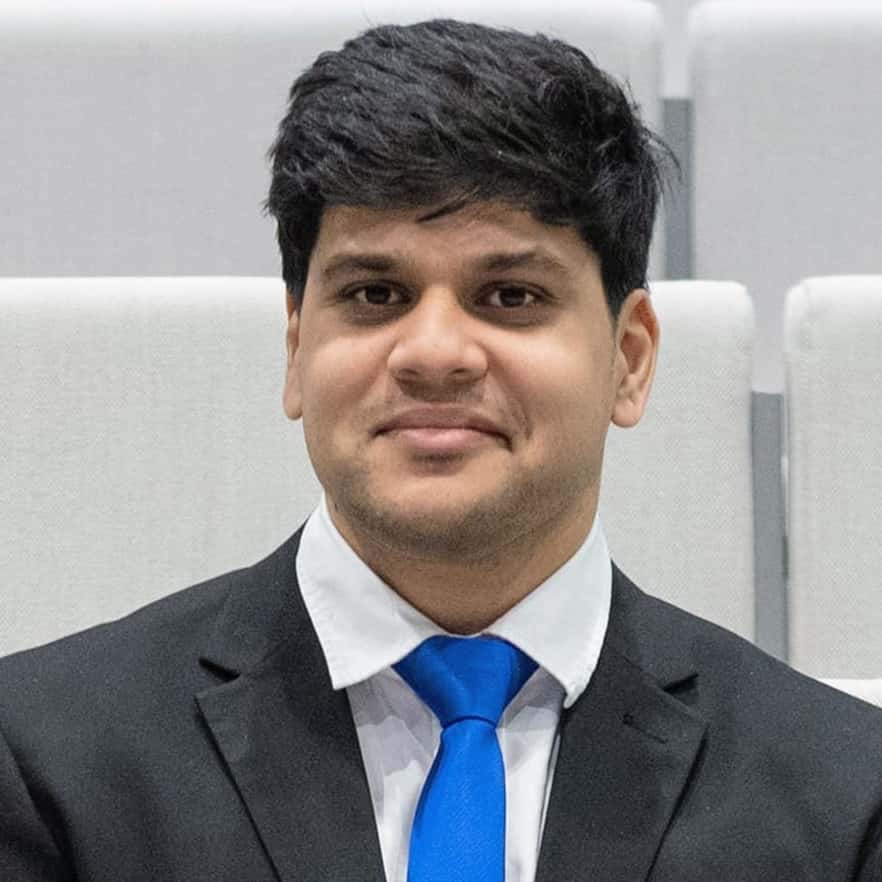
We're looking for researchers to join our team.
Get in touch if you're interested.
Partners & Affiliations
We collaborate with leading research institutions and organisations advancing neuroscience, consciousness research, and synthetic biology.



Frequently Asked Questions
Synconetics prioritises process-world-line fidelity over computational simulation. Unlike approaches that rely on destructive scanning or copying, synconetics aims to maintain the unbroken causal chain of physical dynamics underlying consciousness. This means gradual, non-destructive transitions that preserve continuity rather than creating replicas.
Substrate transitions must be gradual to leverage the brain's plasticity and adaptive capacity. By progressively integrating synthetic neural substrates with biological brain tissue without interrupting the process-world-line, we ensure changes remain within the system's ability to adapt. Continuity is validated through both physical metrics and first-person reportability.
Our research focuses on three primary directions: (1) biohybrid neural grafts for gradual tissue replacement, (2) artificial hemispheric complements for functional integration via high-bandwidth brain-machine interfaces, and (3) protocols for verifying process-world-line fidelity throughout transition. All approaches prioritise gradual, testable transitions that preserve continuity.
Copy-based survival methods sever the original's causal continuity, creating replicas rather than preserving the original process-world-line. Destructive scanning terminates the original substrate, risking death without verifiable assurance of qualia preservation. Approaches that branch or interrupt the original process-world-line do not constitute survival by our criteria, as they fail to maintain the unbroken causal chain essential for conscious continuity.
Our open-science mandate ensures that all protocols, datasets, and hardware designs are published openly to enable independent replication and verification. This transparency is essential for validating claims about process-world-line fidelity and ensuring that research advances can be independently verified by the scientific community.
Death remains the single greatest source of human suffering and loss, every year, roughly 60 million people die, each taking with them irreplaceable knowledge, relationships, and perspectives. Synconetics addresses this not through speculative promises but through rigorous, verifiable engineering. If successful, the technologies developed here would represent the most significant advancement in human wellbeing in history: the elimination of involuntary death. Unlike approaches that require faith in untestable claims about consciousness, our methodology prioritises empirical verification and gradual, validated transitions. Philanthropic funding at this stage supports foundational research that commercial interests typically avoid due to long time horizons, yet the potential impact dwarfs nearly any other cause area.
As an early-stage focused research organisation, we are at a point where every contribution has meaningful impact. We welcome philanthropic funding and donations, contributions from $5,000 onwards directly move the needle on our research progress. Whether through one-time donations, ongoing support, or research grants, your contribution helps us develop and validate the foundational protocols for consciousness-preserving substrate transitions.